.png)
When Sleep Stops Feeling Like Rest
- Daniel Currie
- Jun 23
- 11 min read

Updated: Jul 8

There is a kind of tired that sleep can fix.
And then there is a kind of tired that follows you into bed.
You sleep.
You wake up.
And somehow, nothing feels restored.
The room still feels heavy.
Your mind still feels crowded.
Your body still feels like it is carrying yesterday, last week, and three things you never said out loud.
So you go back to sleep.
Not because you are lazy.
Not because you do not care.
Not because you are weak.
But because sleep has started to feel like the only place life cannot reach you.
That is when sleep stops feeling like rest.
That is when sleep starts becoming a hiding place.
Sleep Is Supposed to Help
Sleep is not the enemy.
Let’s start there.
Sleep is not laziness. Sleep is not failure. Sleep is not something you should have to earn by running yourself into the ground first.
Sleep is one of the ways your body repairs itself. It is one of the ways your mind sorts through the noise. It is one of the ways your nervous system gets a chance to lower the volume.
After stress, grief, burnout, anxiety, depression, conflict, school pressure, work pressure, family pressure, or emotional overload, needing more sleep can make complete sense.
Sometimes the healthiest thing you can do is close the door.
Put the phone down.
Stop answering everything.
Stop performing.
Stop pretending.
And sleep.
That kind of rest matters.
The problem is not that sleep feels good.
The problem begins when sleep becomes the only thing that feels safe.
Because there is a difference between using sleep to recover and using sleep to disappear.
One gives something back.
The other only hides the bill until morning.
The Difference Between Rest and Escape
Rest usually leaves you with something.
Maybe not energy bursting through the ceiling.
Maybe not some magical sunrise version of yourself who suddenly wants to clean the whole house, answer every
message, forgive every person, and become emotionally invincible by noon.
But rest usually gives you something.
A little steadiness.
A little space.
A little more ability to breathe without feeling crushed.
Escape feels different.
Escape may give relief for a while, but it does not always give restoration.
It turns down the noise, but the noise is still waiting.
It pauses the scene, but it does not change what happens next.
That does not make escape evil.
Sometimes the mind reaches for whatever will lower the pressure fastest.
Sometimes sleep is the only door that seems unlocked.
And when someone is overwhelmed enough, that door can feel like mercy.
But here is where the line starts to matter:
Rest says, “I need to recover.”
Escape says, “I do not want to be awake for this part of my life.”
That is not an accusation.
It is information.
It is your mind trying to tell you something about what being awake has started to feel like.
Signs Sleep Has Become a Hiding Place
This is not about one lazy Saturday.
This is not about sleeping in after a brutal week.
This is not about needing a nap because your body finally called a board meeting and said, “We are done.”
This is about a pattern.
And patterns are worth noticing.
Not because you should shame yourself.
Because shame is usually part of what keeps the pattern alive.
These signs are not proof that something is wrong with you.
They are mirrors.
They are invitations to pay attention.
Sleep may be turning into a hiding place when you wake up and immediately want to go back to sleep, not because your body still needs rest, but because being awake feels too much.
It may be happening when sleep becomes the easiest way to avoid messages, decisions, responsibilities, conversations, school, work, or emotions you do not know how to face yet.
It may be happening when you feel guilty after waking up, but that guilt still does not help you move.
It may be happening when daytime feels too loud, too exposed, or too demanding, while your bed feels like the only place nobody can ask anything from you.
It may be happening when you sleep longer but feel less restored.
Or when naps stop feeling like a recharge and start feeling like an exit.
Or when your bed slowly becomes less of a place to rest and more of a place to vanish.
The warning sign is not always how many hours you slept.
Sometimes it is what you were hoping sleep would protect you from.
Why Sleep Can Feel Safer Than Being Awake
Sleep asks very little from you.
That is part of its comfort.
Sleep does not ask you to explain yourself.
Sleep does not ask why you are behind.
Sleep does not ask why you have not answered that text.
Sleep does not ask why you are not over it yet.
Sleep does not ask you to smile, perform, decide, respond, explain, defend, or keep it together.
Sleep simply lets you leave the room without moving.
And when waking life feels emotionally expensive, that kind of quiet can become dangerously attractive.
Not bad.
Not wrong.
Attractive.
Because when life feels too heavy, sleep can start to feel like the only place where nothing is actively hurting you.
No conflict.
No pressure.
No pretending.
No one watching.
No one needing.
No one asking what is wrong.
For some people, sleep becomes a private shelter.
For others, it becomes the one place where guilt, fear, stress, loneliness, or shame cannot speak as loudly.
And for a while, that can feel like peace.
But false peace has a cost.
Because if sleep becomes the only place you feel safe, then waking up starts to feel like losing safety.
That is how the bed becomes heavier.
Not because you are lazy.
Because the world outside it feels loaded.
Why Sleep Stops Feeling Like Rest
One of the most frustrating parts of this pattern is that it does not always make sense from the outside.
You slept.
Maybe you slept a lot.
So why are you still tired?
Why do your eyes open and your chest already feels tight?
Why does the day feel like it is standing over you before your feet even touch the floor?
Because sleep can help the body, mind, and nervous system.
But sleep cannot always untangle what you are waking up afraid to face.
There is physical tiredness.
There is mental tiredness.
There is emotional exhaustion.
There is nervous-system exhaustion.
And sometimes they all pile into the same bed.
A person can sleep ten hours and still wake up carrying dread.
Or grief.
Or pressure.
Or loneliness.
Or shame.
Or the feeling that they are already behind before the day even begins.
That does not mean sleep failed.
It means sleep was being asked to fix more than sleep can fix alone.
Sleep can give your body repair time.
It can give your mind a break.
It can soften the sharp edges for a while.
But if the same fear, stress, conflict, or unfinished pain is waiting outside the blanket every morning, waking up may still feel like returning to a room you were trying to escape.
Sometimes sleep does its job.
It is just not the only job that needs doing.

A Quick Note on Sleep Needs
Sleep needs are different by age and person. As a general guide, adults usually need at least 7 hours of sleep per day. Teenagers often need more, commonly around 8 to 10 hours per 24 hours.
But this blog is not only about the number.
It is about whether sleep is helping you return to your life, or whether it has become the only place you feel able to leave it.
When the Quiet Feels Safer Than Starting Again
For some people, the problem is not just sleeping too much.
Sometimes the harder part is that the quiet hours feel safer than whatever comes next.
That matters.
Because not everyone who stays up late is being irresponsible.
Some people are naturally more awake at night.
Some people work nights.
Some people struggle with insomnia.
Some people think better when the world gets quiet.
Some people are dealing with school stress, work pressure, family chaos, anxiety, depression, grief, or responsibilities that make their waking hours feel crowded before they even begin.
And sometimes the quiet becomes the only part of life that feels like it belongs to you.
No appointments.
No phone calls.
No school bells.
No work demands.
No one asking why you look tired.
No one needing you to become functional on command.
Just quiet.
Just space.
Just a few hours where the world finally stops grabbing at your sleeve.
So rest gets pushed off.
Not because you are trying to ruin anything.
Sometimes because going to sleep means giving up the only part of the day that did not feel like survival.
But eventually, you have to start again.
And starting again feels heavy.
You wake up tired.
You feel behind.
You feel guilty.
Everything feels louder again.
So you push through, shut down, nap, avoid, collapse, or promise yourself next time will be different.
Then the quiet comes back.
And finally, finally, you can breathe.
So you stay there.
Again.
That is the loop.
Life feels overwhelming.
The quiet feels safe.
Starting again feels impossible.
Shame creeps in.
Sleep becomes escape.
And the cycle repeats.
The issue is not that night is bad, or that your schedule is wrong.
Night can be peaceful. Night can be creative. Night can be restorative.
The issue is when the quiet becomes the only place you feel like yourself, and leaving it starts to feel like stepping back into survival.
That is when the pattern is worth noticing.
Not with shame.
With honesty.
Because surviving in the quiet is not the same as resting through it.
Do Not Shame Yourself Awake
This part matters.
A lot.
Because shame is loud.
Shame loves simple explanations.
It says, “You are lazy.”
It says, “You are wasting your life.”
It says, “Other people can handle this, so why can’t you?”
It says, “Just get up.”
And sometimes, shame can shove you into motion for a little while.
You might get up angry.
You might force yourself through the day.
You might answer the message, make the appointment, do the chore, go to school, go to work, or pretend you are fine.
But shame is a terrible long-term alarm clock.
It may get you moving.
It does not make you feel safe being awake.
And that is the difference.
If sleep has become a hiding place, insulting yourself usually makes the bed feel even harder to leave.
Because now you are not only waking up to the original problem.
You are waking up to the original problem plus the voice telling you that you are pathetic for struggling with it.
That is not motivation.
That is weight.
A better question is not, “What is wrong with me?”
A better question is, “What feels so hard to wake up to?”
That question changes the room.
It does not excuse every habit.
It does not pretend there are no responsibilities.
It simply moves the conversation from character failure to emotional information.
Maybe you are not lazy.
Maybe you are overwhelmed.
Maybe you are grieving.
Maybe you are anxious.
Maybe your life has been too loud for too long.
Maybe your body is tired, but your mind is scared.
Maybe sleep became the hiding place because being awake started feeling unsafe in ways you have not fully named yet.
You do not need to insult yourself into being alive today.
You need to understand what part of being awake has started to feel unbearable.
Small Ways to Let Sleep Become Rest Again
This is the part where many people expect the grand solution.
Fix your schedule.
Build the perfect sleep routine overnight.
Drink water.
Exercise.
Never touch your phone.
Journal your feelings under moonlight while becoming a brand-new person by Thursday.
No.
Not here.
Because when sleep has become a hiding place, the goal is not to fix your whole life overnight.
The goal is to build one small bridge back into the day.
Start by naming what sleep is doing for you.
Not judging it.
Naming it.
Is sleep helping you recover?
Is it helping you avoid?
Is it protecting you from something?
Is it numbing something?
Is it delaying something?
Is it the only place you feel safe?
The answer matters because you cannot change a pattern you are too ashamed to look at.
Then choose one return anchor.
Not ten.
One.
Open the curtain.
Sit up before checking your phone.
Put your feet on the floor.
Drink water.
Start coffee.
Wash your face.
Step outside for two minutes.
Feed the pet.
Turn on one light.
Send one safe person a simple message.
The anchor does not have to fix everything.
It only has to help you return.
That is the point.
Also, try not to negotiate with your whole life from bed.
That is a rigged fight.
The whole day will almost always win.
From bed, everything looks bigger.
Every task looks connected to every other task.
One email becomes the whole inbox.
One dish becomes the whole kitchen.
One conversation becomes the whole relationship.
One hard feeling becomes the whole future.
So do not ask, “How am I going to handle today?”
Ask, “What is the next small thing?”
Not the perfect thing.
Not the impressive thing.
The next thing.
And make the first few minutes after sleep as gentle as possible.
Not luxurious.
Not unrealistic.
Gentle.
You are trying to teach your body that coming back does not always mean punishment.
That matters.
Because if every return to the day begins with panic, pressure, shame, or self-attack, of course sleep starts looking like the better option.
Let rest stay part of the plan.
You do not have to hate sleep to heal this.
You do not have to become someone who leaps out of bed with heroic music playing in the background.
You are allowed to need rest.
You are allowed to move slowly.
You are allowed to take this seriously without turning it into another reason to attack yourself.
The goal is not to stop resting.
The goal is to stop disappearing inside it.
When the Pattern Needs More Support
Sometimes this is more than a habit.
Sometimes sleep changes are connected to depression, anxiety, trauma, grief, chronic stress, medication, physical health, pain, loneliness, or a nervous system that has been running on emergency power for too long.
So if this pattern has been going on for a while, or if sleep has become the main way you survive the day, it may be time to let someone safe know.
A doctor.
A therapist.
A parent.
A trusted friend.
A school counselor.
Getting support does not mean you failed.
It means the pattern deserves more care than self-blame.
Especially if you are sleeping much more than usual, sleeping much less than usual, waking up exhausted every day, missing important parts of life, or feeling like you do not want to be awake at all.
That last one matters.
If being awake feels unbearable, you should not have to carry that alone.
Not because you are broken.
Because you are human.
And humans are not built to disappear quietly while everyone assumes they are just tired.
Coming Back Without Fixing Everything First
The goal is not to hate sleep.
The goal is to let sleep become rest again.
A place to recover.
A place to repair.
A place to close your eyes without needing to escape your entire life.
Because sleep is not the problem.
The problem is when sleep becomes the only place that feels safe.
And if that is happening, the answer is not shame.
The answer is noticing.
Gently.
Honestly.
Bravely, even if it does not feel brave.
Noticing what you are trying not to wake up to.
Noticing what the day has started to demand from you.
Noticing where rest stopped restoring you and started hiding you.
And then building one small bridge back.
Not a whole new life.
Not a dramatic transformation.
Not a perfect morning routine wrapped in fake sunshine.
One bridge.
One anchor.
One small return.

This post is Part 2 of the Mental Horizons series, Rest & Hiding. If you missed Part 1, “When Rest Turns Into Hiding,” it looks at how rest can slowly become a place to disappear. Continue to Part 3, “How to Come Back Without Fixing Everything First,” a gentle return to life one small step at a time.


Continue the Rest & Hiding Series
Part 1: When Rest Turns Into Hiding
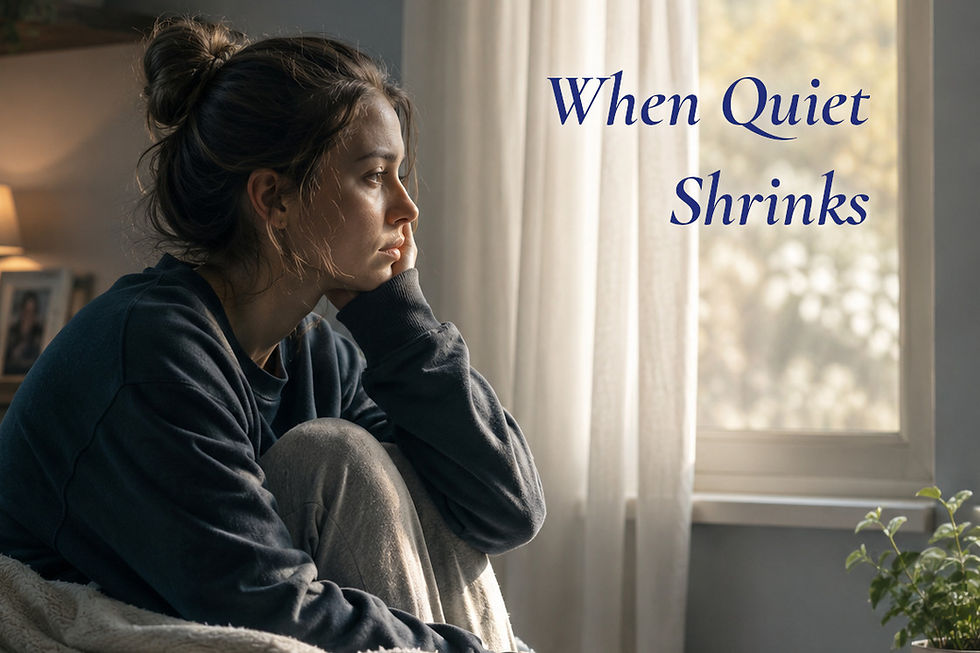
When Quiet Shrinks
When rest stops giving back and starts making life smaller.
Part 3: How to Come Back Without Fixing Everything First
One Small Return
A gentle return to life, one small step at a time.
Updated July 8, 2026: Series navigation added.


Comments